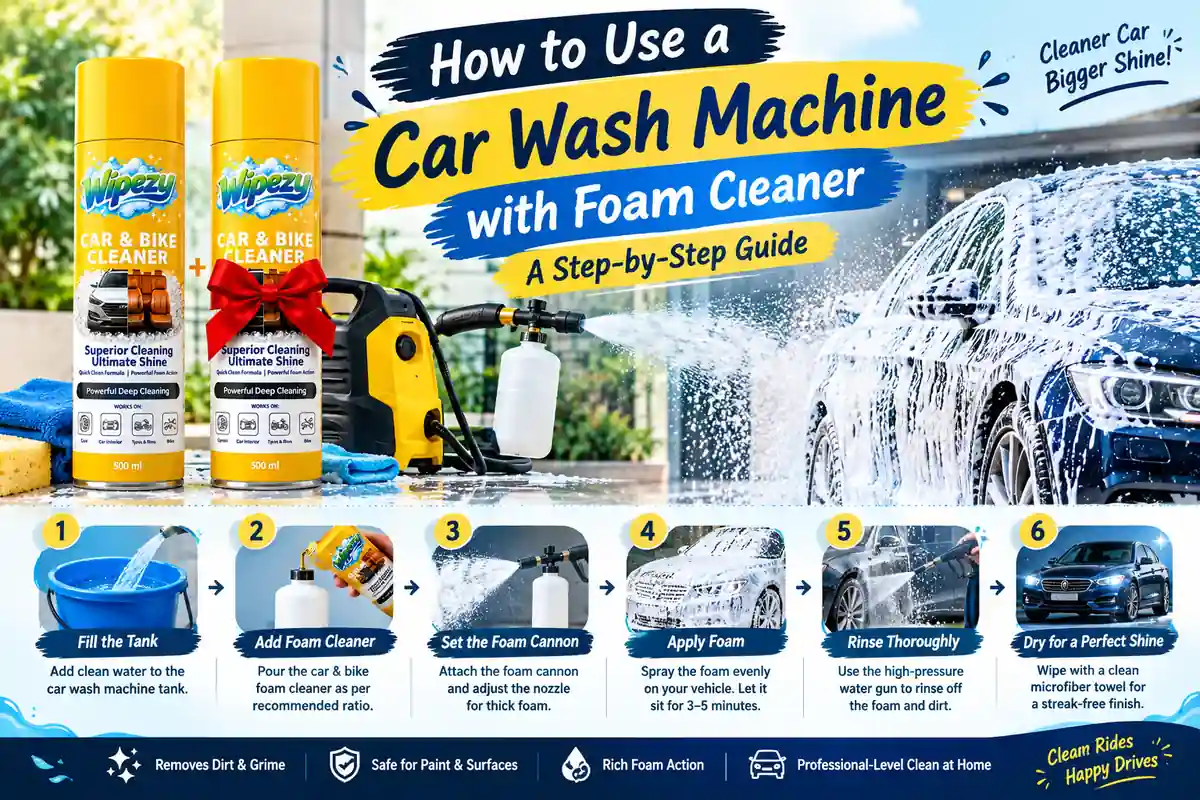
How to Use a Car Wash Machine with Foam Cleaner: A Step-by-Step Guide
By Wipezy Author8 min read
Table of contents
Give the car a plain-water rinse with the car wash machine first, holding the nozzle about 30 cm (a ruler's length) off the paint. Fill the foam bottle with car shampoo and water, then foam the car starting low and moving up. Wait two or three minutes, less in the heat, and rinse from the roof down. Dry with microfibre.
Most car wash machines in Indian homes have the same story. Bought during a sale, used with a lot of excitement on the first Sunday, then pushed behind the scooter in the parking for months. Ask the owner why and you'll hear something like "the foam was just water" or "it dried on the bonnet and left marks."
Both problems are easy to fix, and neither has much to do with the machine being cheap. It's mostly the shampoo mix, the bottle you're using and where you point the nozzle. Get those sorted and a car wash machine is faster and kinder to your paint than a bucket and sponge ever was. For the small stuff in between, a bird dropping or a dusty dashboard, you don't need to drag the machine out at all; a ready-to-use spray like the best foam cleaner from our range handles that in a minute. What follows is the full wash, done the way you'd do it in a society parking with one tap and not much space.
Know What You're Holding Before You Start
Open the box of most home car wash machines sold here and you'll find more or less the same set. Motor unit, a high-pressure hose, the gun, a lance or nozzle that clicks into the gun, and often a little foam bottle thrown in. Specs vary, but to give you a rough idea, one fairly common 1800W model is rated up to 120 bar and pushes out about 6.5 litres of water a minute.
That little foam bottle is usually behind the watery foam. It does make bubbles, sort of, but they run straight off the door. A separate foam lance (people also call it a foam cannon) is wider and has a mesh inside, and that mesh is what beats air into the shampoo and gives you the thick, shaving-cream kind of foam. Worth buying if you plan to use the machine regularly. Just check the connector matches your gun first, because brands don't all use the same fitting.
Mixing the Shampoo Right
Shampoo in the bottle, water on top. The label on the shampoo bottle is your first guide. No ratio printed? Around 100 ml of shampoo topped up to a litre is a common place to start, and warm water mixes in noticeably better than cold water from the tank. Then there is a little knob on top of most lances, which decides how much of that mix gets pulled into the water flow. Don't test it on the car.
Point it at the floor or a wall, give it a short burst and look. Foam sliding off instantly means you need more soap, so turn the knob up and add a bit more shampoo. Foam sitting there like a block of paneer means you've overdone it. And stick to car shampoo. Dish soap and washing powder will foam just fine, but they take the wax off along with the dirt.
How to Use a Car Wash Machine with Foam, Step by Step
Shade helps a lot, so if there's none, go early in the morning before the sun gets to the car. Hook up the water and open the tap all the way before the machine goes on.
-
With the motor still off, press the trigger for a few seconds so water pushes the air out. Now switch on.
-
Plain water first, roof to bumper, to get rid of loose dust and grit.
-
Lance on. Foam from the bottom panels upwards.
-
Two to three minutes of waiting, less on a hot afternoon.
-
Rinse, this time starting at the roof, with the wide fan spray and slow side-to-side sweeps.
-
Car really filthy? One pass with a soft wash mitt before the last rinse.
-
Microfibre towel straight after, or you'll get water spots.
Why foam bottom-up? The lower doors and bumpers carry the most road muck, so this way they get the longest soak. Rinsing from the top then lets everything run down and off in one go. Foam won't take off every bit of the thin oily film on a car that's gone a few weeks without a wash, which is where step 6 comes in. Our full hand wash routine goes through that mitt part properly if you want it.
How Close Should the Nozzle Be?
About 30 cm. That's not a number someone made up: Volvo's owner manual says the nozzle shouldn't come closer than 30 cm to the car and should be moved in sweeping movements. Picture a school ruler between the tip and the paint. And keep it moving, because parking the jet on one spot is how paint gets damaged.
A few spots need even more care. Door locks. The rubber beading around doors and windows. Parking sensors, the reversing camera, badges stuck on with adhesive, and anywhere the paint is already chipped. A hard jet can push water inside or lift an edge. Keep the wide fan spray on the body and use the narrow pencil jet only on tyres, mud flaps and inside the wheel arches.
How Much Water Does a Car Wash Machine Use?
A lot less than a garden pipe, provided you let go of the trigger now and then. Do the maths with 6.5 litres a minute: ten minutes of spraying without a break would come to roughly 65 litres. But nobody actually sprays for ten minutes straight. The first rinse and the last rinse take a few minutes between them, foaming takes very little, and if you release the trigger while walking around the car, the real figure ends up well under that. Handy to know if your society secretary keeps a close eye on the water tank.
No tap anywhere near where you park? Some machines can draw water from a bucket through a suction hose, though not all, so check your manual. If yours can, remember that a 20-litre bucket runs dry in about three minutes of non-stop spraying at that flow rate. Keep a second bucket filled, or do the car in two halves.
Looking After the Machine After Every Wash
Spend five minutes on the machine once the car's done and it'll last a lot longer. Empty the foam bottle, put plain water in it and spray until it comes out clear. Old shampoo dries inside the mesh, and that's the most common reason foam goes thin after a few months. Turn the motor off first, then squeeze the trigger to release the pressure still in the hose, disconnect, and let it all drain.
Keep the machine indoors, and coil the hose loosely rather than folding it. Two habits wear these machines out faster than anything else. Running the motor with no water coming through, which heats up the pump. And a wet plug or extension board sitting on a wet floor. Earthed socket, connection kept dry, every time.
Days When You Don't Need the Machine
Hauling out the car wash foam machine makes sense for the weekly wash. It doesn't for one bird dropping on the bonnet or a layer of dust on the dashboard. That's what a spray foam car wash product is for. No water, no pipe: spray it on, wait a minute, wipe with microfibre. Keep a can in the boot and those little marks get dealt with the same day, while the machine comes out on Sunday.
Before You Start Next Time
So, with Wipexzy, a proper foam lance, the right shampoo mix, a ruler's length between the nozzle and paint, and five minutes of clean-up at the end, using a car wash machine becomes simple and effective. Get these basics right, and your car wash machine will no longer be gathering dust behind the scooter.
Frequently Asked Questions
Q1. Is a car wash machine safe for car paint?
A. It is, as long as you stay around 30 cm away, keep it on the wide fan spray and steer clear of chipped bits. Most damage happens when someone holds a narrow jet right up close.
Q2. Why is my car wash foam machine giving watery foam?
A. Almost always it's one of three things: too little shampoo in the mix, the lance knob turned too low, or the mesh clogged with dried shampoo. Check those first.
Q3. Can I use dish soap in the foam bottle?
A. Best not to. It strips the wax and the paint can start looking dull. Car shampoo costs a little more for a reason.
Q4. Can I wash my bike with the same machine?
A. You can. Just keep the jet off the chain, the wiring, the wheel bearings and the area around the meter console. More foam, less pressure.
Q5. Can I clean the engine bay with it?
A. We wouldn't. High pressure can force water into connectors and the fuse box. A damp cloth does the job, or leave it to the service centre.